

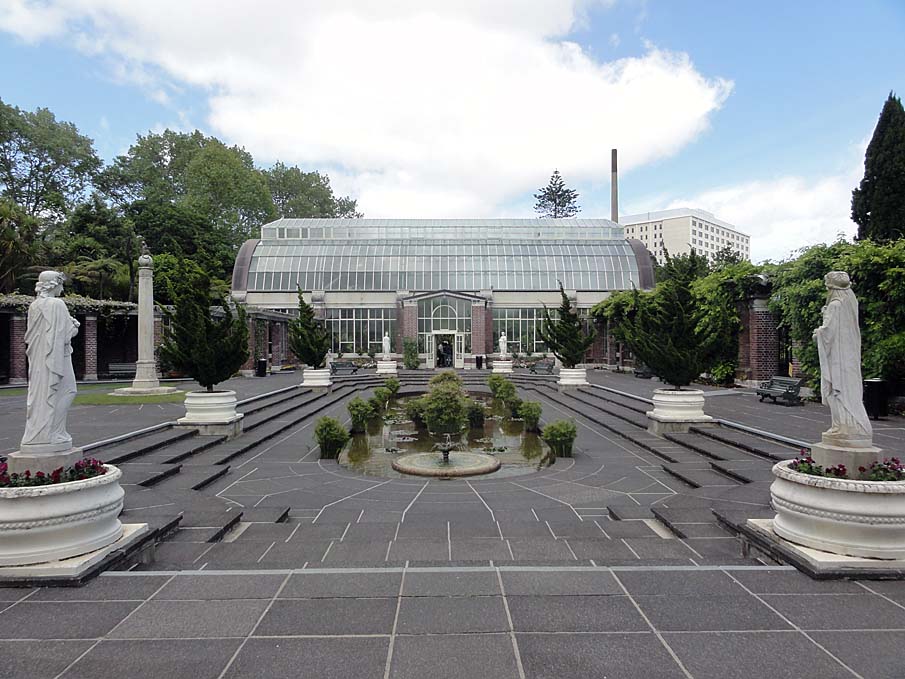
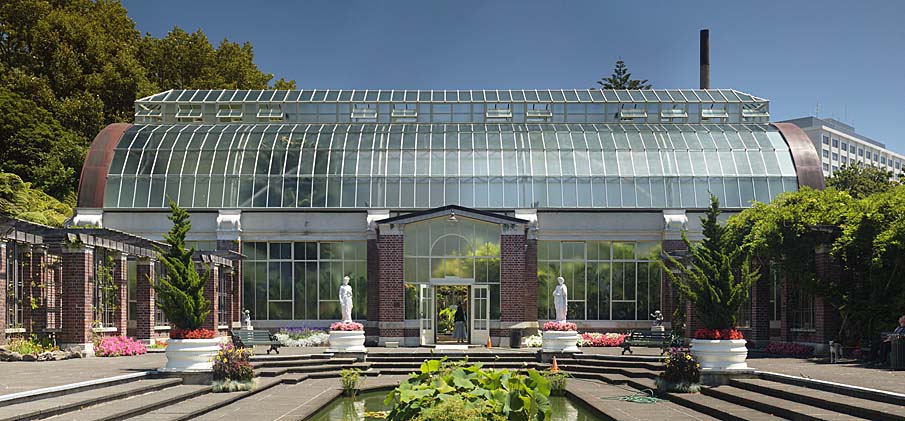
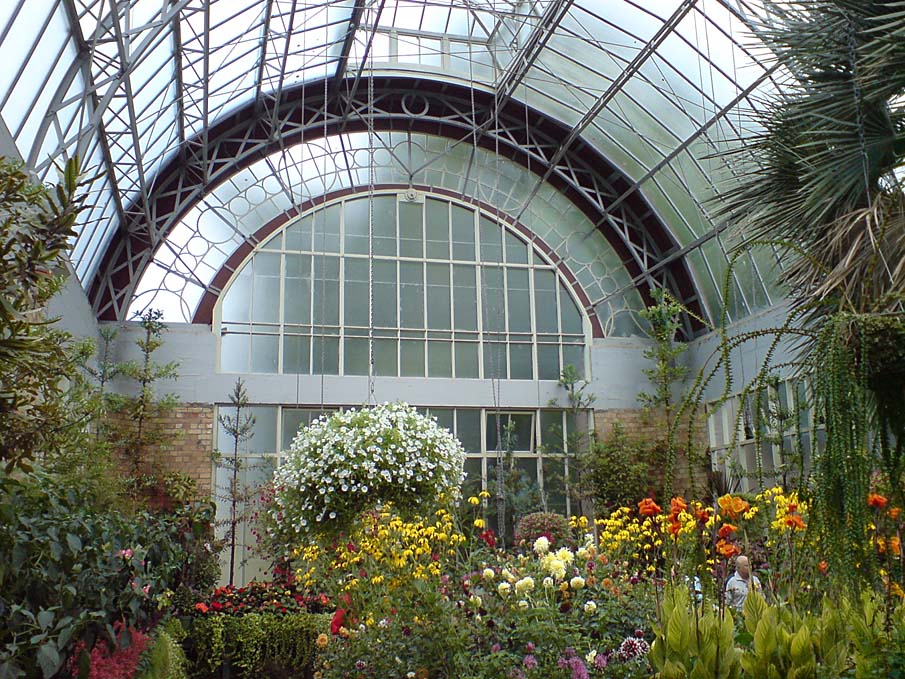
The structures were designed by William Henry Gummer and Charles Reginald Ford, who were among the leading architects of their day. The Temperate and Tropical houses are barrel-vaulted steel and glass structures, arranged symmetrically on either side of the complex. They are separated by the enclosed courtyard, while the Fernery occupies a more irregular grotto setting to the rear. The courtyard contains a number of statues, added in 1945, and a sunken pond that was modified in 1954. Each structure within the Wintergardens was designed to display different types of flora, the Temperate House having exotic potted plants and the Tropical House more permanent plantings, such as banana and ravanela (traveller's palm). The fernery is notable for its display of New Zealand plants, some of which may have come from a collection that won the first Loder Cup in 1926. The cup was established by the New Zealand Institute of Horticulture to encourage the appreciation and cultivation of native flora.
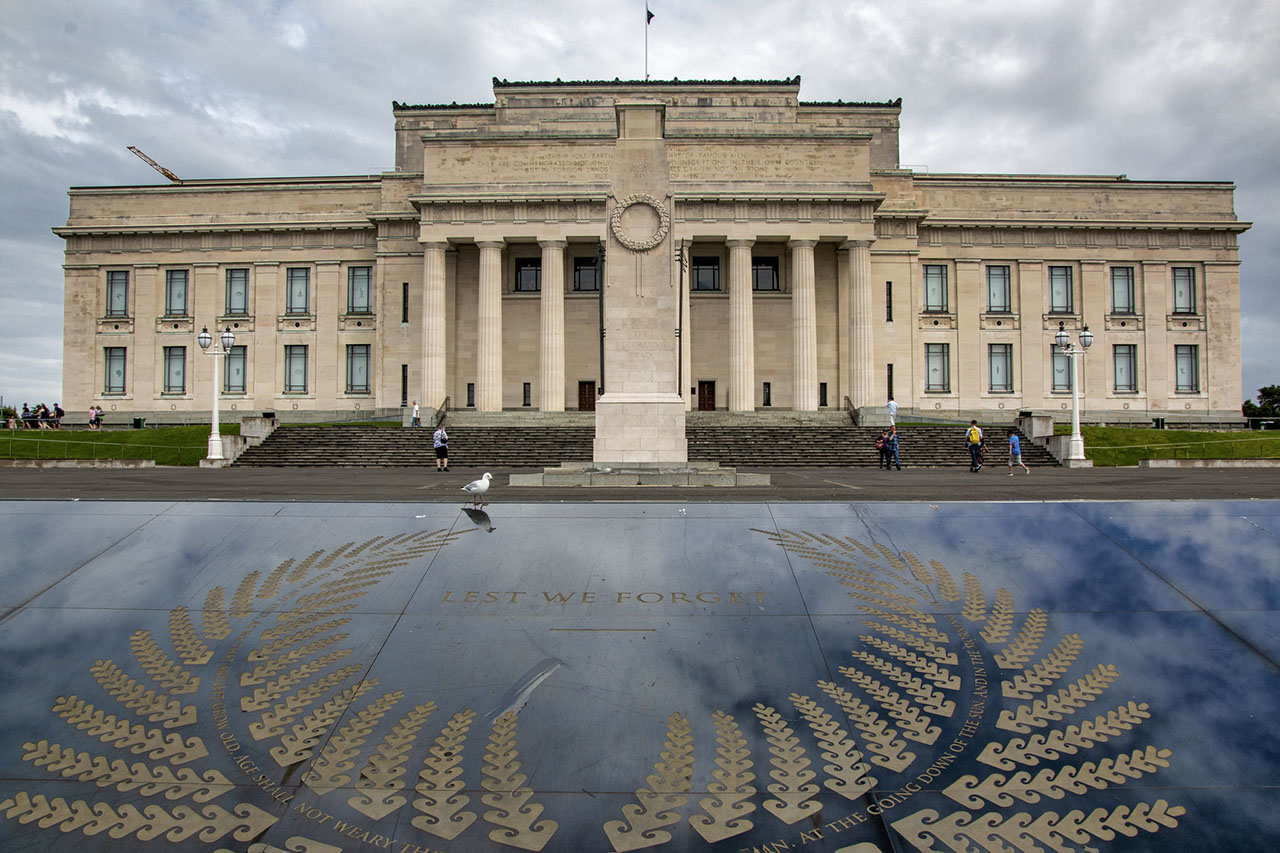
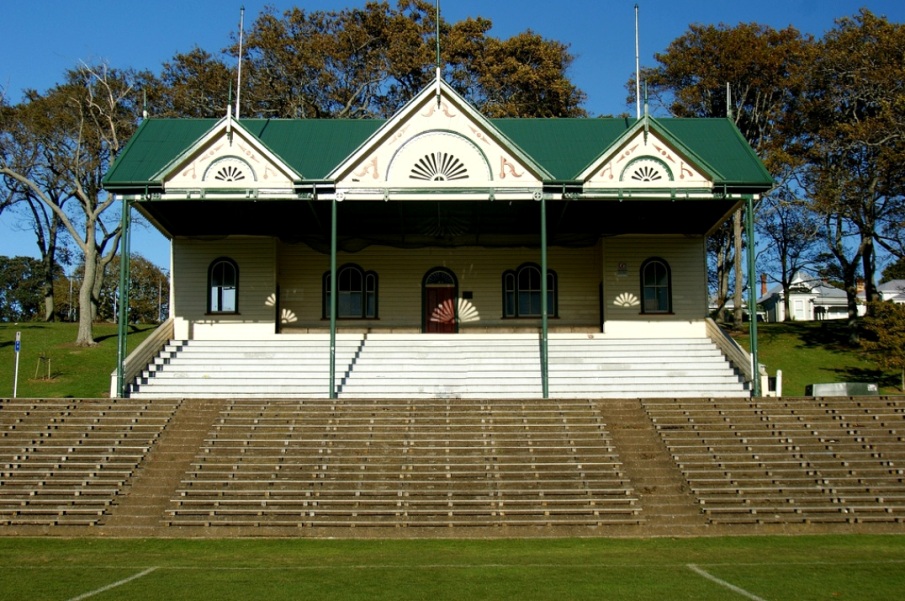
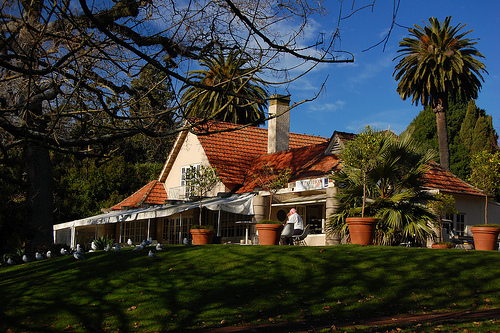
The Domain Wintergardens are among the best-preserved examples of their kind in the country and are nationally significant for demonstrating early twentieth-century garden design. They demonstrate attitudes to the natural world at that time, including an interest in exotic flora 'discovered' during European colonial expansion. They are particularly important for reflecting changes in approach to flora during the 1920s, with a growing emphasis on New Zealand plants. The Wintergardens are also significant for their association with the Auckland Industrial, Agricultural and Mining Exhibition, and the role of public parks as places of education and recreation. They are important for showing the architectural versatility of Gummer and Ford, and the value placed on public buildings in the early twentieth century. They have connections with other historic structures in the park - including the nearby rotunda, tea kiosk and Auckland War Memorial Museum - and enjoy high public esteem as popular and much-visited buildings.
List Entry Information
Status
Listed
List Entry Status
Historic Place Category 1
Access
Able to Visit
List Number
124
Date Entered
21st September 1989
Date of Effect
21st September 1989
City/District Council
Auckland Council
Region
Auckland Council
Legal description
Pt Auckland Domain (RT NA75C/138), North Auckland Land District
Status
Listed
List Entry Status
Historic Place Category 1
Access
Able to Visit
List Number
124
Date Entered
21st September 1989
Date of Effect
21st September 1989
City/District Council
Auckland Council
Region
Auckland Council
Legal description
Pt Auckland Domain (RT NA75C/138), North Auckland Land District
Why is this place significant?
Historic Significance
Historical Significance or Value The foundation stone of the Cool House reads: 'In commemoration of the Auckland Industrial, Agricultural and Mining Exhibition 1913-14 this building was erected and these grounds laid out from the profits earned by the Auckland Exhibition'. The driving force behind the scheme was George Elliot, Exhibition Chairman and Chairman of the Bank of New Zealand. The Exhibition profits of £4000 were used and a large amount of the construction cost was covered by donations from Auckland benefactors. This second stage was completed by Fletcher Construction for a cost of £19500. The complex was opened by the Mayor of Auckland, George Baildon, on May 2 1928. In the New Zealand context the Wintergardens was a further example of a civilising impulse at a time when New Zealand was moving beyond its colonial infancy.
Physical Significance
Architectural Significance: The Wintergardens conform to a well-defined model of nineteenth century garden structures and is typical of the later and more refined examples of glasshouse design. It portrays some of Gummer's architectural ideas assimilated from his overseas experience. The skilful use of materials and the competence with which the totality of the design has been carried out mark this complex as the finest example of its kind in New Zealand. Townscape/Landmark Significance: The Wintergardens are part of a most notable complex of buildings. Its distinctive form harmonizes with the parkland and complements the nearby dominant mass of the Auckland War Memorial Museum.
Why is this place significant?
Historic Significance
Historical Significance or Value The foundation stone of the Cool House reads: 'In commemoration of the Auckland Industrial, Agricultural and Mining Exhibition 1913-14 this building was erected and these grounds laid out from the profits earned by the Auckland Exhibition'. The driving force behind the scheme was George Elliot, Exhibition Chairman and Chairman of the Bank of New Zealand. The Exhibition profits of £4000 were used and a large amount of the construction cost was covered by donations from Auckland benefactors. This second stage was completed by Fletcher Construction for a cost of £19500. The complex was opened by the Mayor of Auckland, George Baildon, on May 2 1928. In the New Zealand context the Wintergardens was a further example of a civilising impulse at a time when New Zealand was moving beyond its colonial infancy.
Physical Significance
Architectural Significance: The Wintergardens conform to a well-defined model of nineteenth century garden structures and is typical of the later and more refined examples of glasshouse design. It portrays some of Gummer's architectural ideas assimilated from his overseas experience. The skilful use of materials and the competence with which the totality of the design has been carried out mark this complex as the finest example of its kind in New Zealand. Townscape/Landmark Significance: The Wintergardens are part of a most notable complex of buildings. Its distinctive form harmonizes with the parkland and complements the nearby dominant mass of the Auckland War Memorial Museum.
Construction Professional
Name
Frederick Wilson
Type
Builder
Biography
No biography is currently available for this construction professional
Name
Gummer & Ford
Type
Architectural Partnership
Biography
The architectural partnership of Gummer and Ford was established in 1923, and became one of national importance. William Henry Gummer (1884-1966) was articled to W.A. Holman, an Auckland architect, and was elected as an Associate of the Royal Institute of British Architects in 1910. In the period 1908-1913 he travelled in the United Kingdom, Europe and the United States. During this time he worked for Sir Edwin Lutyens, leading English architect of the time, and for Daniel Burnham in Chicago. Burnham was a major American architect and one of the founders of the influential Chicago School of Architecture. Gummer joined the firm of Hoggard and Prouse of Auckland and Wellington in 1913. In 1914 he was elected a Fellow of the New Zealand Institute of Architects, was president of the Institute from 1933-34 and was later elected a life member. Charles Reginald Ford (1880- 1972) was born in England and served in the Royal Navy. He was later with Captain Scott's 1901-1904 expedition to Antarctica. He trained as an architect working in Wanganui as an engineer. In 1926 he wrote the first treatise on earthquake and building construction in the English language. Ford was president of the New Zealand Institute of Architects from 1921-22. Buildings designed by the partnership include the State Insurance Building Wellington, (1940) the Dilworth Building (1926), the Guardian Trust Building and the Domain Wintergardens (1921 and 1928), all in Auckland, and the Dominion Museum (1936) in Wellington. Gummer and Ford were awarded Gold Medals from the New Zealand Institute of Architects for the designs of Auckland Railway Station and Remuera Library. Gummer was one of the most outstanding architects working in New Zealand in the first half of this century and was responsible for the stylistically and structurally advanced Tauroa (1916), Craggy Range (1919), Arden (1926), and Te Mata (1935) homesteads at Havelock North.
Name
Fletcher Construction Company
Type
Builder
Biography
Fletcher Construction Company was founded by Scottish-born James Fletcher (1886 - 1974), the son of a builder. Six months after his arrival in Dunedin in 1908, Fletcher formed a house-building partnership with Bert Morris. They soon moved into larger-scale construction work, building the St Kilda Town Hall (1911), and the main dormitory block and Ross Chapel at Knox College (1912). Fletcher's brothers, William, Andrew and John joined the business in 1911, which then became known as Fletcher Brothers. A branch was opened in Invercargill. While holidaying in Auckland in 1916, James tendered for the construction of the the Auckland City Markets. By 1919 the company, then known as Fletcher Construction, was firmly established in Auckland and Wellington. Notable landmarks constructed by the company during the Depression included the Auckland University College Arts Building (completed 1926); Landmark House (the former Auckland Electric Power Board Building, 1927); Auckland Civic Theatre (1929); the Chateau Tongariro (1929); and the Dominion Museum, Wellington (1934). Prior to the election of the first Labour Government, Fletcher (a Reform supporter) had advised the Labour Party on housing policy as hbe believed in large-scale planning and in the inter-dependence of government and business. However, he declined an approach by Prime Minister Michael Joseph Savage in December 1935 to sell the company to the government, when the latter wanted to ensure the large-scale production of rental state housing. Although Fletchers ultimately went on to build many of New Zealand's state houses, for several years Residential Construction Ltd (the subsidiary established to undertake their construction) sustained heavy financial losses. Fletcher Construction became a public company, Fletcher Holdings, in 1940. Already Fletchers' interests were wide ranging: brickyards, engineering shops, joinery factories, marble quarries, structural steel plants and other enterprises had been added the original construction firm. Further expansion could only be undertaken with outside capital. During the Second World War James Fletcher, having retired as chairman of Fletcher Holdings, was seconded to the newly created position of Commissioner of State Construction which he held during 1942 and 1943. Directly responsible to Prime Minister Peter Fraser, Fletcher had almost complete control over the deployment of workers and resources. He also became the Commissioner of the Ministry of Works, set up in 1943, a position he held until December 1945. In 1981 Fletcher Holdings; Tasman Pulp and Paper; and Challenge Corporation amalgamated to form Fletcher Challenge Ltd, at that time New Zealand's largest company. Williamson Construction Company - main contract
Name
Gummer, William Henry
Type
Architect
Biography
Gummer (1884-1966) was articled to W.A. Holman, an Auckland architect, and qualified as an Associate of the Royal Institute of British Architects in 1910. From 1908 to 1913 he travelled in the United Kingdom, Europe and the United States. During this time he worked for Edwin Lutyens, a leading English architect of the time, and for Daniel Burnham in Chicago. Burnham was a major American architect and one of the founders of the influential Chicago School of Architecture. Gummer joined the firm of Hoggard and Prouse of Auckland and Wellington in 1913. Significant commissions undertaken during this period included the New Zealand Insurance (later known as the Guardian Trust) Building, Auckland (1914-18). In 1923 Gummer, one of the most outstanding architects working in New Zealand in the first half of the twentieth century, joined with Charles Reginald Ford (1880-1972) to create an architectural partnership of national significance. The practice was responsible for the design of the Dilworth Building (1926), Auckland, the Dominion Museum (1936) and the State Insurance Building (1940), both Wellington. Gummer and Ford were awarded Gold Medals by the New Zealand Institute of Architects for their designs of the Auckland Railway Station and Remuera Library. Gummer was also responsible for the Bridge of Remembrance, Christchurch and the Cenotaph in Dunedin (1927), and the stylistically and structurally advanced Tauroa (1916), Craggy Range (1919), Arden (1926) and Te Mata (1935) homesteads at Havelock North. Elected a Fellow of the New Zealand Institute of Architects in 1914, he was president of the Institute from 1933-4 and was later elected a life member.
Construction Details
Start Year
1927
Finish Year
1928
Type
Original Construction
Description
Construction of Tropical House, pergola and courtyard
Start Year
1929
Finish Year
1930
Type
Original Construction
Description
Construction of Fernery
Start Year
1945
Type
Addition
Description
Statues added
Start Year
1954
Type
Modification
Description
Ornamental pool remodelled
Start Year
1993
Finish Year
1994
Type
Reconstruction
Description
Fernery pergola rebuilt
Type
Other
Description
Site of scoria quarry
Period
early 1900s
Start Year
1913
Finish Year
1914
Type
Other
Description
Site of Auckland Industrial, Agricultural and Mining Exhibition
Start Year
1916
Finish Year
1921
Type
Original Construction
Description
Construction of Temperate House
Construction Materials
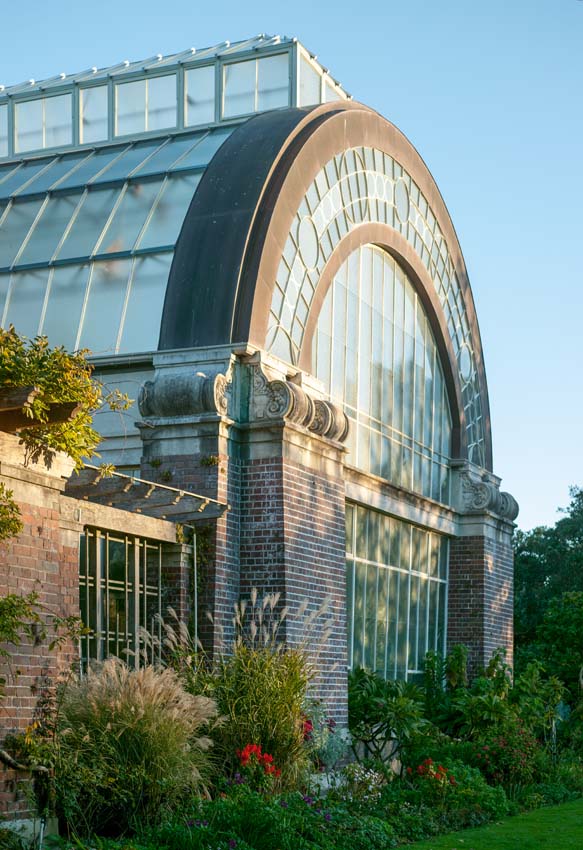
Foundations: Brick piles with reinforced concrete footings. Walls: 0.8 metre square buttressed brick piers, as compressive supports for 100mm x 250mm reinforced concrete lintels acting as ties for the roof structure. This enables an extensive amount of the wall area to be glazed. Roof: Barrel vaulted structure comprised of series of steel lattice trusses. Trusses at 3.3m centres, span 1m are 450mm deep and fixed with 6mm rivets. (Working Drawings held by Hoadley Budge Olphert).
Notable Features
Registration covers all structures within the Wintergarden complex, their fixtures and finishes. It also includes recent modifications. The structures lie on the site of a scoria quarry for the construction of Domain Drive, and the 1913-1914 Auckland Industrial, Agricultural and Mining Exhibition Special Features: The various statues and ornaments occurring throughout the complex.
Construction Professional
Name
Frederick Wilson
Type
Builder
Biography
No biography is currently available for this construction professional
Name
Gummer & Ford
Type
Architectural Partnership
Biography
The architectural partnership of Gummer and Ford was established in 1923, and became one of national importance. William Henry Gummer (1884-1966) was articled to W.A. Holman, an Auckland architect, and was elected as an Associate of the Royal Institute of British Architects in 1910. In the period 1908-1913 he travelled in the United Kingdom, Europe and the United States. During this time he worked for Sir Edwin Lutyens, leading English architect of the time, and for Daniel Burnham in Chicago. Burnham was a major American architect and one of the founders of the influential Chicago School of Architecture. Gummer joined the firm of Hoggard and Prouse of Auckland and Wellington in 1913. In 1914 he was elected a Fellow of the New Zealand Institute of Architects, was president of the Institute from 1933-34 and was later elected a life member. Charles Reginald Ford (1880- 1972) was born in England and served in the Royal Navy. He was later with Captain Scott's 1901-1904 expedition to Antarctica. He trained as an architect working in Wanganui as an engineer. In 1926 he wrote the first treatise on earthquake and building construction in the English language. Ford was president of the New Zealand Institute of Architects from 1921-22. Buildings designed by the partnership include the State Insurance Building Wellington, (1940) the Dilworth Building (1926), the Guardian Trust Building and the Domain Wintergardens (1921 and 1928), all in Auckland, and the Dominion Museum (1936) in Wellington. Gummer and Ford were awarded Gold Medals from the New Zealand Institute of Architects for the designs of Auckland Railway Station and Remuera Library. Gummer was one of the most outstanding architects working in New Zealand in the first half of this century and was responsible for the stylistically and structurally advanced Tauroa (1916), Craggy Range (1919), Arden (1926), and Te Mata (1935) homesteads at Havelock North.
Name
Fletcher Construction Company
Type
Builder
Biography
Fletcher Construction Company was founded by Scottish-born James Fletcher (1886 - 1974), the son of a builder. Six months after his arrival in Dunedin in 1908, Fletcher formed a house-building partnership with Bert Morris. They soon moved into larger-scale construction work, building the St Kilda Town Hall (1911), and the main dormitory block and Ross Chapel at Knox College (1912). Fletcher's brothers, William, Andrew and John joined the business in 1911, which then became known as Fletcher Brothers. A branch was opened in Invercargill. While holidaying in Auckland in 1916, James tendered for the construction of the the Auckland City Markets. By 1919 the company, then known as Fletcher Construction, was firmly established in Auckland and Wellington. Notable landmarks constructed by the company during the Depression included the Auckland University College Arts Building (completed 1926); Landmark House (the former Auckland Electric Power Board Building, 1927); Auckland Civic Theatre (1929); the Chateau Tongariro (1929); and the Dominion Museum, Wellington (1934). Prior to the election of the first Labour Government, Fletcher (a Reform supporter) had advised the Labour Party on housing policy as hbe believed in large-scale planning and in the inter-dependence of government and business. However, he declined an approach by Prime Minister Michael Joseph Savage in December 1935 to sell the company to the government, when the latter wanted to ensure the large-scale production of rental state housing. Although Fletchers ultimately went on to build many of New Zealand's state houses, for several years Residential Construction Ltd (the subsidiary established to undertake their construction) sustained heavy financial losses. Fletcher Construction became a public company, Fletcher Holdings, in 1940. Already Fletchers' interests were wide ranging: brickyards, engineering shops, joinery factories, marble quarries, structural steel plants and other enterprises had been added the original construction firm. Further expansion could only be undertaken with outside capital. During the Second World War James Fletcher, having retired as chairman of Fletcher Holdings, was seconded to the newly created position of Commissioner of State Construction which he held during 1942 and 1943. Directly responsible to Prime Minister Peter Fraser, Fletcher had almost complete control over the deployment of workers and resources. He also became the Commissioner of the Ministry of Works, set up in 1943, a position he held until December 1945. In 1981 Fletcher Holdings; Tasman Pulp and Paper; and Challenge Corporation amalgamated to form Fletcher Challenge Ltd, at that time New Zealand's largest company. Williamson Construction Company - main contract
Name
Gummer, William Henry
Type
Architect
Biography
Gummer (1884-1966) was articled to W.A. Holman, an Auckland architect, and qualified as an Associate of the Royal Institute of British Architects in 1910. From 1908 to 1913 he travelled in the United Kingdom, Europe and the United States. During this time he worked for Edwin Lutyens, a leading English architect of the time, and for Daniel Burnham in Chicago. Burnham was a major American architect and one of the founders of the influential Chicago School of Architecture. Gummer joined the firm of Hoggard and Prouse of Auckland and Wellington in 1913. Significant commissions undertaken during this period included the New Zealand Insurance (later known as the Guardian Trust) Building, Auckland (1914-18). In 1923 Gummer, one of the most outstanding architects working in New Zealand in the first half of the twentieth century, joined with Charles Reginald Ford (1880-1972) to create an architectural partnership of national significance. The practice was responsible for the design of the Dilworth Building (1926), Auckland, the Dominion Museum (1936) and the State Insurance Building (1940), both Wellington. Gummer and Ford were awarded Gold Medals by the New Zealand Institute of Architects for their designs of the Auckland Railway Station and Remuera Library. Gummer was also responsible for the Bridge of Remembrance, Christchurch and the Cenotaph in Dunedin (1927), and the stylistically and structurally advanced Tauroa (1916), Craggy Range (1919), Arden (1926) and Te Mata (1935) homesteads at Havelock North. Elected a Fellow of the New Zealand Institute of Architects in 1914, he was president of the Institute from 1933-4 and was later elected a life member.
Construction Details
Start Year
1927
Finish Year
1928
Type
Original Construction
Description
Construction of Tropical House, pergola and courtyard
Start Year
1929
Finish Year
1930
Type
Original Construction
Description
Construction of Fernery
Start Year
1945
Type
Addition
Description
Statues added
Start Year
1954
Type
Modification
Description
Ornamental pool remodelled
Start Year
1993
Finish Year
1994
Type
Reconstruction
Description
Fernery pergola rebuilt
Type
Other
Description
Site of scoria quarry
Period
early 1900s
Start Year
1913
Finish Year
1914
Type
Other
Description
Site of Auckland Industrial, Agricultural and Mining Exhibition
Start Year
1916
Finish Year
1921
Type
Original Construction
Description
Construction of Temperate House
Construction Materials
Foundations: Brick piles with reinforced concrete footings. Walls: 0.8 metre square buttressed brick piers, as compressive supports for 100mm x 250mm reinforced concrete lintels acting as ties for the roof structure. This enables an extensive amount of the wall area to be glazed. Roof: Barrel vaulted structure comprised of series of steel lattice trusses. Trusses at 3.3m centres, span 1m are 450mm deep and fixed with 6mm rivets. (Working Drawings held by Hoadley Budge Olphert).
Notable Features
Registration covers all structures within the Wintergarden complex, their fixtures and finishes. It also includes recent modifications. The structures lie on the site of a scoria quarry for the construction of Domain Drive, and the 1913-1914 Auckland Industrial, Agricultural and Mining Exhibition Special Features: The various statues and ornaments occurring throughout the complex.
Architectural Description (Style): The Domain Wintergardens' dominant decorative impulse is found in its constructional elements; the lattice structure of the roof trusses, the circular window mullions; the roof lantern and the contrast of masonry buttresses with the intricacy of the steel structure. Applied decoration had been kept to a minimum, being found in the detailed plaster plinths, window ledges and cornices. The only overt use of decoration as secondary elements is found in the scrolled caps on top of the brick piers and the scrolled reliefs on the bargeboards fronting the entrance porticos to each glass house. The complex comprises two barrel vaulted steel and glass structures, supported on buttressed brick piers, separated along a secondary axis by an enclosed court featuring a sunken pool. The entrance follows the major symmetrical axis, which terminates in an informal grotto fernery. The complex overlooks the Domain Kiosk and duck ponds and the panorama of harbour and city. The paved courtyard and pool with its accompanying Jarrah pergola colonnades binds the two vaulted structures into a single architectural composition.
Architectural Description (Style): The Domain Wintergardens' dominant decorative impulse is found in its constructional elements; the lattice structure of the roof trusses, the circular window mullions; the roof lantern and the contrast of masonry buttresses with the intricacy of the steel structure. Applied decoration had been kept to a minimum, being found in the detailed plaster plinths, window ledges and cornices. The only overt use of decoration as secondary elements is found in the scrolled caps on top of the brick piers and the scrolled reliefs on the bargeboards fronting the entrance porticos to each glass house. The complex comprises two barrel vaulted steel and glass structures, supported on buttressed brick piers, separated along a secondary axis by an enclosed court featuring a sunken pool. The entrance follows the major symmetrical axis, which terminates in an informal grotto fernery. The complex overlooks the Domain Kiosk and duck ponds and the panorama of harbour and city. The paved courtyard and pool with its accompanying Jarrah pergola colonnades binds the two vaulted structures into a single architectural composition.
Historical and Associated Iwi / Hapū / Whānau
Completion Date
21st August 2001
Report Written By
Martin Jones
Information Sources
Auckland University
Auckland University
Bush, 1971
G .W. A. Bush, 'Decently and In Order: The Government of the City of Auckland 1840-1971', Auckland, 1971
New Zealand Building Progress
New Zealand Building Progress
New Zealand Herald
New Zealand Herald, 12 July 1932, p. 6; 28 September 1933, p. 6.
New Zealand Historic Places Trust (NZHPT)
New Zealand Historic Places Trust
New Zealand Institute of Architects Journal
New Zealand Institute of Architects Journal (NZIA), No.8, Aug 1974
Pevsner, 1976
Nikolaus Pevsner, A History of Building Types, London, 1976
Fleming, 1980
John Fleming, Hugh Honour and N. Pevsner, Dictionary of Architecture, London, 1980 The Penguin Dictionary of Architecture, Third Edition, Harmondsworth 1980
Macmillian Encyclopedia of Architects, 1982
Macmillan Encyclopedia of Architects. The Free Press, New York, 1982
Kohlmaier, 1981
G Kohlmaier & B Von Sartory. Houses of Glass. A Nineteenth Century Building Type. MIT Press, Massachusetts, 1981
Auckland City Council
Auckland City Council
Other Information
This historic place was registered under the Historic Places Act 1980. This report includes the text from the original Building Classification Committee report considered by the NZHPT Board at the time of registration. Please note that entry on the New Zealand Heritage List/Rarangi Korero identifies only the heritage values of the property concerned, and should not be construed as advice on the state of the property, or as a comment of its soundness or safety, including in regard to earthquake risk, safety in the event of fire, or insanitary conditions.
Historical and Associated Iwi / Hapū / Whānau
Completion Date
21st August 2001
Report Written By
Martin Jones
Information Sources
Auckland University
Auckland University
Bush, 1971
G .W. A. Bush, 'Decently and In Order: The Government of the City of Auckland 1840-1971', Auckland, 1971
New Zealand Building Progress
New Zealand Building Progress
New Zealand Herald
New Zealand Herald, 12 July 1932, p. 6; 28 September 1933, p. 6.
New Zealand Historic Places Trust (NZHPT)
New Zealand Historic Places Trust
New Zealand Institute of Architects Journal
New Zealand Institute of Architects Journal (NZIA), No.8, Aug 1974
Pevsner, 1976
Nikolaus Pevsner, A History of Building Types, London, 1976
Fleming, 1980
John Fleming, Hugh Honour and N. Pevsner, Dictionary of Architecture, London, 1980 The Penguin Dictionary of Architecture, Third Edition, Harmondsworth 1980
Macmillian Encyclopedia of Architects, 1982
Macmillan Encyclopedia of Architects. The Free Press, New York, 1982
Kohlmaier, 1981
G Kohlmaier & B Von Sartory. Houses of Glass. A Nineteenth Century Building Type. MIT Press, Massachusetts, 1981
Auckland City Council
Auckland City Council
Other Information
This historic place was registered under the Historic Places Act 1980. This report includes the text from the original Building Classification Committee report considered by the NZHPT Board at the time of registration. Please note that entry on the New Zealand Heritage List/Rarangi Korero identifies only the heritage values of the property concerned, and should not be construed as advice on the state of the property, or as a comment of its soundness or safety, including in regard to earthquake risk, safety in the event of fire, or insanitary conditions.
Current Usages
Uses: Civic Facilities
Specific Usage: Fountain
Uses: Civic Facilities
Specific Usage: Garden - public
Uses: Civic Facilities
Specific Usage: Glasshouse/conservatory/fernery - public
Uses: Civic Facilities
Specific Usage: Statue/public art
Uses: Commemoration
Specific Usage: Monuments, memorial, site of particular event - other
Former Usages
General Usage: Civic Facilities
Specific Usage: Fountain
Current Usages
Uses: Civic Facilities
Specific Usage: Fountain
Uses: Civic Facilities
Specific Usage: Garden - public
Uses: Civic Facilities
Specific Usage: Glasshouse/conservatory/fernery - public
Uses: Civic Facilities
Specific Usage: Statue/public art
Uses: Commemoration
Specific Usage: Monuments, memorial, site of particular event - other
Former Usages
General Usage: Civic Facilities
Specific Usage: Fountain
Location
Related listings
Stay up to date with Heritage this month
